The Weapon Thai Fighters Respect More Than the Knockout
Ask a Thai trainer which strike they'd least like to eat, and most won't say the kick. They'll say the elbow. Muay Thai calls itself the art of eight limbs: two fists, two shins, two knees, two elbows. Of those eight, the elbow is the one that ends fights on cuts rather than knockouts. A ringside doctor waving off a bout because a fighter can't see through the blood over their eye is one of the most common finishes in Thailand, and it's almost always an elbow that opened the cut.
That's the part beginners usually miss. Elbow strikes, or "sok" in Thai, aren't about knockout power the way a kick or a right hand is. They're about surface area. The point of the elbow is a hard, narrow edge of bone with almost no padding over it. Land that edge on skin stretched over the brow, the cheek, or the bridge of the nose, and it splits like a knuckle on a hard countertop. That's the whole design.
The Core Elbow Strikes Every Fighter Learns
Thai gyms don't teach elbows as a single technique. They teach a small family of them, each named for its angle and its job. Here are the ones you'll actually see used in a Muay Thai ring.
Sok Tat: The Horizontal Elbow
The most common elbow in Muay Thai. The arm swings across the body roughly parallel to the ground, the same path a hook takes, except the elbow leads instead of the fist. It targets the temple, cheekbone, or bridge of the nose, and it's usually the first elbow a fighter drills because the mechanics mirror a punch they already know.
Sok Ngat: The Uppercut Elbow
Thrown from below, driving upward into the chin or jaw, sok ngat is the elbow equivalent of an uppercut. It works best at close range, often right after a fighter slips a punch and comes up inside their opponent's guard. Because it travels a short, steep path, it's difficult to see coming.
Sok Phung: The Thrusting Elbow
A straight, spearing strike where the elbow drives forward rather than around. Fighters use it to close distance suddenly, catching an opponent who's stepping in without expecting contact from that angle.
Sok Klap: The Spinning Elbow
The most dramatic of the family and the one crowds react to. The fighter rotates the body a full turn and strikes with the back of the elbow, generating power from the spin rather than the arm alone. It's high-risk because it turns the fighter's back to their opponent for a split second, so it's typically saved for a moment when an opponent is already backing up or has been stunned.
Sok Sap: The Downward Chop
A chopping elbow dropped from above, usually onto the top of the head or the crown of the skull during clinch exchanges when a fighter's head is pulled down. It's brutal at close range and one of the reasons the clinch is treated as its own phase of the fight rather than a pause between strikes.
There are more variations than these five, including sok klap khu, a double spinning elbow thrown in quick succession, and kradot sok, a jumping elbow that closes distance against a fighter who's circling out of range. Most gyms don't rush students to those. They're advanced tools built on the same five fundamentals, and a fighter who hasn't drilled sok tat and sok ngat until they're automatic has no business attempting a spinning double elbow in a live round.
Where Most Elbows Actually Land: The Clinch
Fans who only watch highlight reels tend to picture elbows as a strike thrown from a distance, the way a kick is. In practice, a huge share of elbows land from inside the clinch, where fighters are already controlling each other's head and shoulders. That's not an accident. Once you've got a grip on your opponent's neck, you've also removed their ability to duck or back away from a short elbow. Trainers in muay khao gyms, the clinch-heavy style covered in our breakdown of Muay Thai's fighting styles, will often say a fighter who can't control the clinch will never land a clean elbow, because the setup matters more than the strike itself.
Stance Is Half the Technique
There's a reason Thai fighters stand square to their opponent instead of bladed like a boxer. A squared stance, which we cover in more depth in our piece on Muay Thai stance, keeps both elbows equally live at all times. A boxer standing sideways has a lead arm and a rear arm with very different jobs. A Muay Thai fighter standing square can throw sok tat off either side without resetting their feet first. Watch closely and you'll notice fighters who throw fast, unpredictable elbow combinations are almost always the ones with the squarest, most balanced stance. Take that same square stance and turn it sideways like a boxer's, and half the elbow arsenal disappears with it. That trade-off, giving up a smaller target profile in exchange for two live weapons instead of one, is exactly why the stance looks the way it does.
Why the Sport Treats Elbows Differently
Muay Thai wasn't always fought with the padded gloves and rope-wrapped fists you see today. Older forms of the sport, including what's now called muay boran, allowed rope-bound hands and comparatively little else protecting the face, and elbows carried even more weight in deciding a fight. Modern rules and equipment softened plenty of that, but the elbow itself is one of the few weapons that never got diluted. It's still bare, still bone, and still the fastest route to a doctor stoppage in the sport.
What the Rules Actually Allow
Elbows are legal in professional Muay Thai under IFMA rules, including spinning and jumping variations. But the sport treats them carefully at the amateur level. Cadet and junior amateur divisions typically remove elbow strikes from the ruleset entirely, since the cut risk is considered too high for fighters still developing their defense. Even in adult amateur competition, referees and ringside doctors are given more authority to stop a bout early once a cut opens, precisely because elbows can end a fight on a laceration a kick or punch never would. If you're new to the sport and sparring at a gym, don't assume full-contact elbows are standard practice. Most reputable gyms restrict or remove elbows from sparring rounds entirely and only introduce them under padded conditions or controlled drilling.
Training Elbows Without Learning Bad Habits
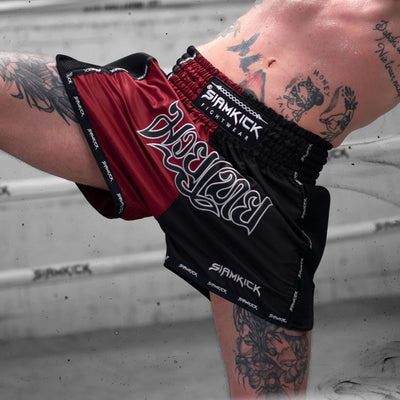
The mistake most beginners make with elbows is treating them like a party trick, something to whip out because it looks aggressive. Thai trainers teach the opposite: elbows come last in a fighter's education, after the jab, the kick, and the clinch are already solid, because a sloppy elbow thrown from bad range just gets a fighter countered. Shadow the angles slowly before adding speed. Drill sok tat off a parry, sok ngat off a slip, and don't touch sok klap until the simpler two are automatic. Clinch work matters just as much as pad work here, and it helps to train in gear that doesn't restrict hip rotation or grip fighting. That's a big part of why we cut our Muay Thai shorts the way we do: a fighter who's fighting their own shorts in the clinch is never going to land a clean elbow.
The Short Version
Elbows are Muay Thai's closest-range, highest-consequence weapon. They're not thrown for knockouts, they're thrown to open cuts and end fights on stoppage. Learn the five core strikes, understand that most of them come out of clinch control rather than open space, and respect why gyms hold off teaching them until the fundamentals are locked in. Master the setup and the elbow takes care of itself.