Ask a Western gym rat what a teep is and you'll usually get some version of "the push kick." Not wrong, exactly. Teep is the Thai word for a push kick, sometimes called the foot jab. But calling it "just a push" is how most casual practitioners waste the best range-control tool in the sport. In a Lumpinee or Rajadamnern ring, the teep decides who controls the pace, who gets to fight their own fight, and who spends three rounds chasing an opponent who's always six inches out of reach.
What a Teep Actually Is
The word itself is straightforward. Teep translates to push kick, and the mechanics back up the name: the ball of the foot drives straight through a target, usually the hip, stomach, solar plexus, or occasionally the face of a fighter who's dropped their guard. What the translation doesn't capture is intent. A teep thrown to shove someone away is a different technique from a teep thrown to control range, break rhythm, and set up the next exchange. Thai fighters treat it as the second one, almost always.
It gets nicknamed the "foot jab" for good reason. Like a boxing jab, its job usually isn't to end the fight on its own. It measures distance, interrupts whatever the opponent was about to do, and buys the split second needed to reset or follow up.
Fighters coming from karate often confuse the teep with the front kick, or mae geri, and the two look related on video but aren't built the same. A karate front kick snaps: the knee lifts, the foot whips upward and strikes at roughly a right angle to the leg, and the karateka often leans back slightly to add distance to the snap. The teep pushes: the knee lifts, then the hips drive forward and the leg extends in a straight line, foot aligned with the shin at contact. One is built to hurt on impact. The other is built to move a person and control where the fight happens. Karate does have a close cousin, the thrusting front kick or mae geri kekomi, which behaves much more like a teep, but it's the exception rather than the rule in most karate curriculums.
The Three Jobs a Good Teep Does
Keeping Range
Against a fighter who wants to close distance and clinch (SIAMKICK's own breakdown of the Muay Thai clinch covers why that's such valuable real estate), a well-timed teep to the hip or stomach stops the advance before it starts. It's the difference between fighting on your own terms and getting walked down for three rounds.
Breaking Rhythm
Fighters build combinations off a rhythm: step, load, fire. A teep thrown into that rhythm, even a soft one, resets the timer. It doesn't need to hurt to work. It needs to interrupt.
Setting Up the Real Damage
Watch enough Muay Thai and you'll notice the teep rarely travels alone. A teep to the stomach that snaps an opponent's posture forward sets up a cross behind it. A teep that turns the hips opens the far side for a switch kick. The push kick is often the setup, not the punchline.
Lead Teep vs. Rear Teep
The lead teep, thrown off the front leg, is fast and cheap in terms of balance risk. It's the one you'll throw most often, mostly for range and rhythm. The rear teep, off the back leg, travels further and can carry real hip drive behind it. It costs more balance and takes longer to land, so it shows up less often, but a clean rear teep can move a much bigger opponent backward or double as a genuine scoring strike rather than just a spacer.
How Judges Actually Score It
This is where a lot of newer fans get confused. In the traditional Thai scoring hierarchy, kicks to the body generally outscore knees, which outscore elbows and punches, but that ranking assumes clean, damaging contact. A teep rarely does damage on its own, so on a pure power-for-power basis it scores below a solid knee or a body kick landed with the shin. Where the teep earns its keep on the scorecards is ring control. A fighter who spends three rounds keeping an aggressive opponent on the end of teeps, denying entries, and dictating where the fight happens is demonstrating exactly the kind of control Thai judges are trained to reward, even when no single teep looked spectacular. This is also where Thai scoring and Western kickboxing or MMA scoring tend to diverge. Judges trained on Thai stadium rules are watching for who controlled the ring over five rounds, while judges scoring under more Western-influenced criteria often weight individual landed strikes more heavily, which is part of why a teep-heavy performance can look dominant in Bangkok and get scored closer everywhere else.
The Mechanics: Chamber, Thrust, Retract
The technique breaks into three phases. First, chamber the knee up toward the chest, the same motion you'd use to start a straight knee strike, which is part of why the teep and the knee share so much of the same setup. Second, thrust: drive the hips forward and extend the leg, striking with the ball of the foot (a heel-first teep works too, especially for pure pushing power, but the ball of the foot gives more precision for scoring shots to the face or solar plexus). Third, and this is the step most beginners skip, retract the leg as fast as it went out. A teep that lingers out there is a leg waiting to get caught and swept.
Where Foreign Fighters Usually Get It Wrong
- Pushing with the toes. It looks like a teep but transfers almost no force and risks a broken toe on a hard target. The ball of the foot or the heel does the actual work.
- Telegraphing the knee chamber. If the knee comes up slowly, the opponent has already stepped offline before the kick arrives.
- Standing square after throwing it. A teep that isn't retracted leaves the kicking leg hanging in range for a low kick or a catch-and-sweep.
- Throwing it flat-footed. Without weight shifted onto the support leg first, the kick has nothing to push off of, and the whole thing turns into an armless shove.
A Trademark Worth Studying
If you want to see the teep taken to its logical extreme, look up footage of Samart Payakaroon, widely considered one of the greatest Muay Thai fighters to ever compete, fighting through the golden era of the sport in the 1980s. His teep wasn't a spacing tool he tolerated between the techniques he actually wanted to throw. It was often the technique itself. Thrown with enough hip drive and timed well enough, Samart's teep reportedly put opponents down outright, a rare feat for a strike most fighters treat as a jab.
Drilling It Into Something Useful
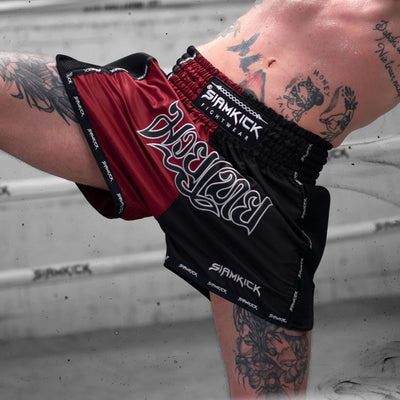
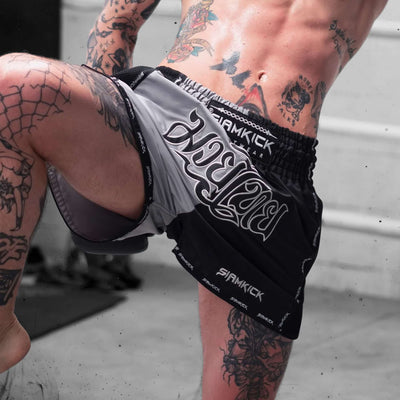
Pad work is where most people first meet the teep, and it's a fine place to start, but the technique only becomes useful once it's drilled moving. Have a partner circle and close distance while you check the range with teeps, mixing lead and rear versions, mixing targets between hip and stomach. Add a follow-up after every third or fourth teep, cross, low kick, doesn't matter what, so the leg stops being just a stop sign and starts being a setup. Full hip extension matters here more than most techniques get credit for. Shorts that bind at the hip or ride up mid-kick cost you inches on every single rep, which is one of the reasons the cut of a pair of Muay Thai shorts matters more than it looks like it should.
The teep won't get you a highlight reel. It also won't get you walked down, out-ranged, or dragged into a clinch you didn't choose. In a sport that rewards fighters who control where and when the exchanges happen, the push kick everyone underestimates is often the one deciding the fight before the bigger shots ever land. Pair it with a sound stance, and you've got the foundation most of Thailand's best fighters build everything else on.