Kids Muay Thai Shorts: A Parent's Sizing and Safety Buying Guide

Updated on  
Kids Muay Thai Shorts: A Parent's Sizing and Safety Buying Guide

If your child is starting Muay Thai, the shorts matter more than you'd expect. Watch a few minutes of a beginner class and you'll see why: a waistband that's too loose starts sliding down mid-kick, and the kid ends up tugging it back up between combinations instead of watching the coach. The wrong fit can also fight the exact range of motion (hip mobility for kicks and knees) that the class is trying to build. This guide covers when kids typically start training, how kids' shorts actually differ from adult ones, and how to size them correctly using real measurements instead of a guess based on age.

What Age Should a Kid Start Muay Thai (and Need Real Gear)?

There's no single official minimum age for starting Muay Thai; it depends on the gym and the program. Many gyms accept kids as young as 4 to 6 in beginner classes, though at that age the focus stays on movement and coordination, not contact.

Ages 5 to 7 are often called the "sweet spot," since kids at this age can usually follow instruction and train consistently a couple of times a week. Readiness isn't really about a birthday. Coaches tend to look for signs like holding focus through 30-45 minutes of group instruction, taking turns without getting distressed, and understanding the difference between play-fighting and technique practice.

From around age 7 to 12, classes usually get more structured: proper technique work, pad work, and light clinch fundamentals. Teens move into heavier pad work and supervised drilling. Across every stage, good programs use age-appropriate drills, clear rules, proper equipment, and hands-on supervision, starting non-contact or light-contact and building intensity gradually as a child matures. A reasonable training frequency for kids is 2–3 sessions a week, and it's worth choosing a gym based on experienced coaches, a clear class structure, safety protocols, and a good coach-to-student ratio.

How Kids' Muay Thai Shorts Are Different from Adult Shorts

Kids' shorts aren't just adult shorts scaled down; not the ones worth buying, anyway.

Cut, scale, and sizing logic

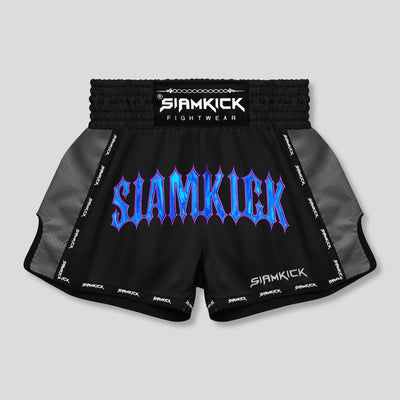
Shorts in the Kids Muay Thai Shorts collection, for example, are cut to the same pattern as the adult range but scaled specifically for younger fighters, not just shrunk down. Kids' sizing is also a genuinely separate scale rather than "extra small adult." SIAMKICK's own kids chart runs XS to M across a 46–56cm waist range, while their adult chart starts at size S with a 66cm (26") waist. Those numbers don't overlap, which is a useful sanity check if you're ever unsure whether a "small" pair is actually made for a child.

One practical note: Asian and Thai-brand sizing, including SIAMKICK's kids line, tends to run smaller than Western sizing. It's also worth knowing that this sizing runs one size smaller than MMA-style shorts, which is useful to keep in mind if you're ever comparing this chart against MMA-style shorts sizing.

Fabric weight

Muay Thai shorts in general are typically made from satin, nylon, polyester-blend, or cotton. Satin is a weave, not a fiber; it can be made from silk, acetate, nylon, or polyester. Polyester-satin is the most common choice because it's stronger and more durable, while nylon is lighter and dries faster. SIAMKICK's kids shorts use MicroSatin, a proprietary microfiber/satin blend, in a lighter weight suited to a smaller, growing body.

How to Size Kids' Muay Thai Shorts Correctly

Measure, don't guess by age

Age is a poor sizing guide because kids grow at wildly different rates. Waist and length matter far more than the number on the birthday cake. The most reliable approach is to measure your child directly and match those numbers to an actual size chart. In practice, that means measuring right after a bath, in just underwear, with the tape held snug but not tight. Kids rarely hold still for a tape measure, so it's worth measuring twice and going with the smaller reading if the two don't match.

The SIAMKICK kids size chart

Here's SIAMKICK's kids size chart:

Size Waist Hips Length Leg Opening
XS 46cm (18") 76cm (30") 25cm (10") 20cm (8")
S 51cm (20") 81cm (32") 28cm (11") 22cm (8.5")
M 56cm (22") 86cm (34") 30cm (12") 23cm (9")

To measure: for the waist, measure the waistband width and double it. Measure hips at their fullest point. Length runs top-to-hem, and leg opening is measured straight across. Allow a tolerance of about ±1 inch when comparing your child's measurements to the chart.

Growth-room vs. safety trade-off

There's a real trade-off to think through here: sizing true-to-measurement gives the most secure, safest fit for training, while sizing up slightly gives a little more room to grow into. There's no fixed rule for exactly how much extra room is appropriate, so use your judgment based on how your child is growing and how soon you expect a size change. But don't size up so much that fit and safety are compromised.

Once you've picked a size, run a quick fit check: the shorts should sit securely at the natural waist without slipping, allow full hip mobility for kicks and knees, and hold through a movement test. Have your child throw a few knees, teeps, and round kicks, and watch the waistband at the hip. That's where a bad fit shows up first, not while they're standing still.

What Makes Shorts Safe and Appropriate for a Child Training Partner

Waistband and tie type

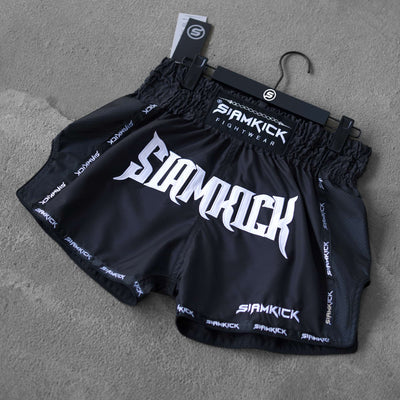
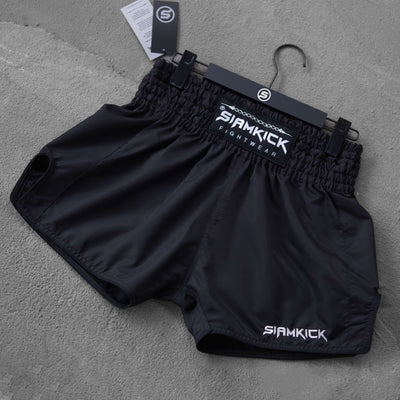
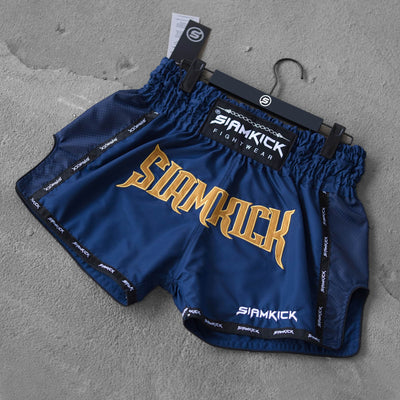
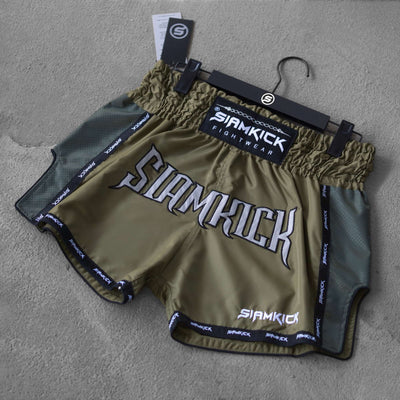
Traditional Muay Thai shorts use a wide elastic waistband with no hard fasteners; no buttons, zippers, or buckles. Many modern pairs add an internal or external drawstring for extra hold during explosive movement. "Tactical Green" Kids Muay Thai Shorts and the rest of SIAMKICK's kids line use exactly this setup: an elastic waistband with drawstring, plus triple-reinforced stitching at stress points.

Length and side slits for kicking range of motion

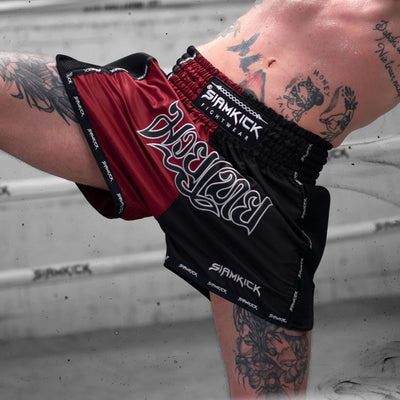
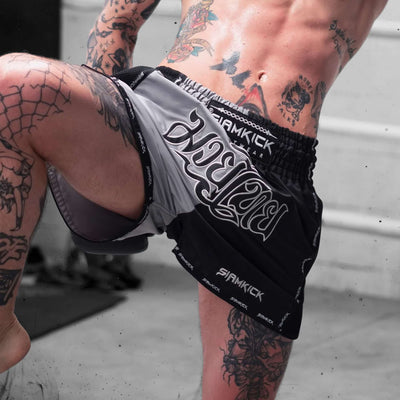
Shorts need side slits or splits that open around the hip and thigh so a high kick doesn't fight the fabric. SIAMKICK's kids shorts feature extra-wide side slits and what the brand calls a "360MOTION opening," designed for unrestricted movement. This is the kind of detail that matters once a kid is actually throwing round kicks and knees in class, not just standing in a stance.

Fabric and stitching

Reinforced seams matter because training is genuinely hard on gear. Cheap stitching and thin fabric won't hold up to repeated washing combined with contact drilling. This is something to check for before you buy, not after a seam blows out mid-class.

Quality and Durability; Buying for a Kid Who Will Outgrow Them

Kids' training gear needs to hold up through regular washing and contact drilling, even though a size change may come sooner than with adult gear. SIAMKICK's kids shorts are made in Thailand, individually handmade, constructed from 100% MicroSatin, machine washable, and backed by a 30-day defect-replacement guarantee.

Improperly cared-for shorts can have stitches or seams fail within months, while proper care extends their working life. This is worth keeping in mind since you're likely buying more than one size over the course of your child's training.

What Gear Does a Kid Actually Need for Their First Muay Thai Class?

For a first class, most kids need surprisingly little: comfortable training clothes, a training towel, and water. Most gyms have loaner gloves and pads available for beginners, so there's no need to buy a full kit before that first session.

Once training becomes a regular thing, the gear list grows:

  • Hand wraps
  • Properly sized gloves
  • Muay Thai shorts cut for high kicks and knees, light and full range of motion, like those in the Kids Muay Thai Shorts collection
  • Shin guards, once sparring starts
  • A mouthguard, once partner drills or sparring begin
  • Headgear, for any sparring

On hand wraps specifically: some coaches note that kids' hand-wrap needs can differ from adults', so it's worth asking your child's coach whether and when wraps are recommended for your child's training level.

One thing worth being upfront about: mongkol headbands and prajiad armbands are traditional pieces some parents like to shop for as a kid progresses. Right now these exist only in one-size, adult-proportioned versions. There's no kids sizing available. If you like the idea, think of them as something to grow into rather than a purchase for right now.

Caring for Kids' Muay Thai Shorts (Washing Without Ruining Them)

Wash in warm water. Use a delicate or machine cycle with a mild detergent, ideally inside a mesh laundry bag, or hand wash by soaking for about 5 minutes and rinsing. Wring gently rather than twisting the fabric.

Turn the shorts inside out before washing, and air dry indoors out of direct sunlight. Avoid the machine dryer. SIAMKICK's kids shorts are listed simply as machine washable, but following the fuller care routine above will help them last through the season.

FAQ

What size Muay Thai shorts does my kid need?

Measure your child's waist, hips, and length rather than going by age, then match those numbers to a real size chart. SIAMKICK's kids size chart runs from XS (46cm/18" waist) up to M (56cm/22" waist), with a tolerance of about ±1 inch.

At what age can a kid start Muay Thai?

There's no universal minimum age; it depends on the gym and program. Many gyms accept kids as early as 4 to 6 for non-contact, coordination-focused classes, with ages 5 to 7 often cited as a sweet spot for consistent training.

Are kids' Muay Thai shorts just smaller adult shorts?

No. A genuine kids line, like SIAMKICK's, is cut to the same pattern as the adult range but scaled specifically for younger fighters and made in a lighter fabric. It's built on its own size scale (XS–M) rather than being a shrunk-down adult small.

Do mongkol headbands and prajiad armbands come in kids' sizes?

Not currently; these are only available in one-size, adult-proportioned versions. If your child is drawn to them, treat them as gear to grow into rather than something to buy now.

Published on  Updated on  

Leave a comment

Please note, comments need to be approved before they are published.